Category Archives: BlackBerry

Liar’s Dice updated

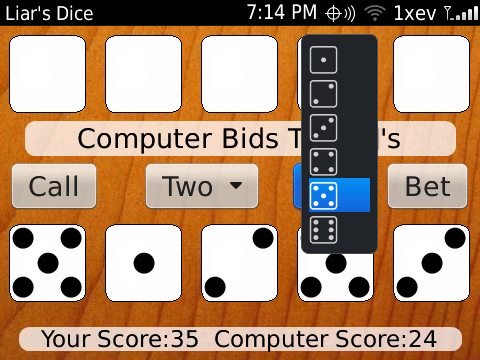
The Liar’s Dice game has been updated to version 1.4 in BlackBerry AppWorld. New in this version is the ability for games to persist over playing sessions. You can now exit the app at any time during the game, and simply resume play when you start the app again. Other changes were made to improve the the efficiency of the app, and the look of the menus.

About Liar’s Dice

This is a classic dice game of strategy and deception in which seeing only your own dice you must bet on the combined dice in play without getting caught in a lie.
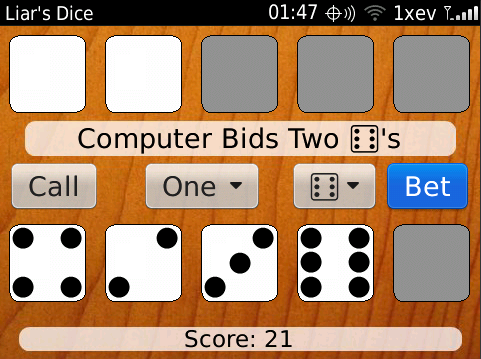
The object of the game is to catch your opponent (the computer) betting too high. Bets are placed on both your own dice which you can see, and your opponent’s dice which are hidden from you. You begin each round by making a bet. The computer then has an opportunity to either call your bet a lie, or to bet higher then you. Then it is once again your turn to call your opponent’s bet or to bet even higher. This continues until eventually a bet is called. Then if the bet is too high the caller wins, or if the bet is not a lie, the bettor wins the round.
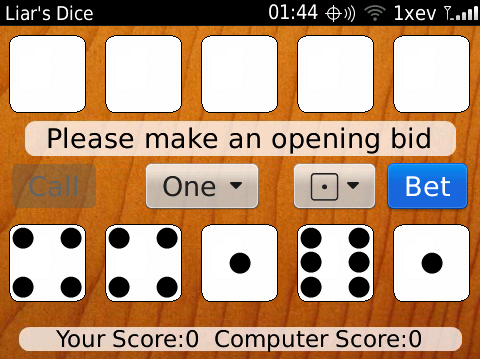
The game has two main game modes. The “High Score” mode is the default mode, points are awarded for each round, and the first to gain a given number of points wins. The amount of points that the game plays to can be selected from the options page, allowing for shorter or longer games.

The second game mode is an “Elimination” mode in which the loser of each round loses one dice for the following rounds, and the last player with any dice left is the winner. This game is more dynamic as there are a different number of dice in play each round. Additionally these games in this mode typically play faster than high score games.

Links & Information

PlayBook and HDMI

Although I have had my BlackBerry PlayBook for almost a year now, I only recently got around to buying a micro HDMI cable so I could hook it up to a television. Long story short, it is a lot of fun (and will be even more useful once we get the Bridge remote later this month).

On Twitter Jeff Bacon mentioned that it should just be included in the box, and he is totally right. I bought the cable online for $2.99 including shipping. Once your remove the extra shipping costs, the (surprisingly large) amount of packaging, and buy it in quantities somewhat larger then one, you could probably assume that RIM could package this with the PlayBook for less then a dollar.

Why would RIM want to do this? Well, because it is a pretty cool feature and adds a lot of out-of-the-box functionality. Also because it is something that neither the iPad nor the Amazon Fire can do. Once OS 2.0 and the Bridge remote is available, this will be even more cool.

If it takes an enthusiast like myself nine months to get around to picking up a cable, you can assume that most costumers probably never will, even if it only takes one use ever for this $3 purchase to pay for itself. At the very least it is more useful then the micro USB cable that is included. I already have plenty of USB cables, and never plug my PlayBook into my computer anyhow.

Until RIM starts including it, I recommend that everyone with a PlayBook to spend the few dollars and buy a cable. It is well worth it.

Binary Clock version 2.0

The Binary Clock application has been updated to version 2.0 in BlackBerry AppWorld. This update improves they layout and design of the menus, as well as add an option to upgrade for additional features for only a dollar. After upgrading, you have the option of setting the Binary Clock, to display by default while the phone is charging, or plugged into a computer. This setting can be turned on or off in the options page.

How to read

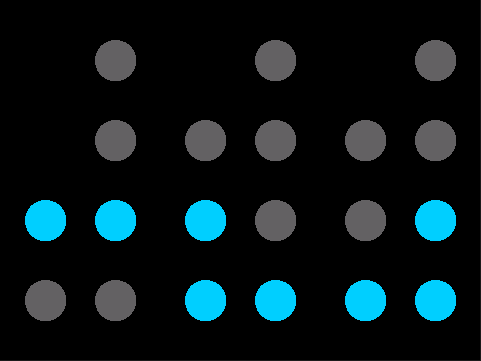
A binary coded decimal can be read with each column added up with each light worth (from top to bottom) 8, 4, 2, and 1, and the column on the left being worth 40, 20, and 10. For example the time in the above image would be 16 hours, 9 minutes, and 25 seconds.

Links & Information

Stats about touchscreens

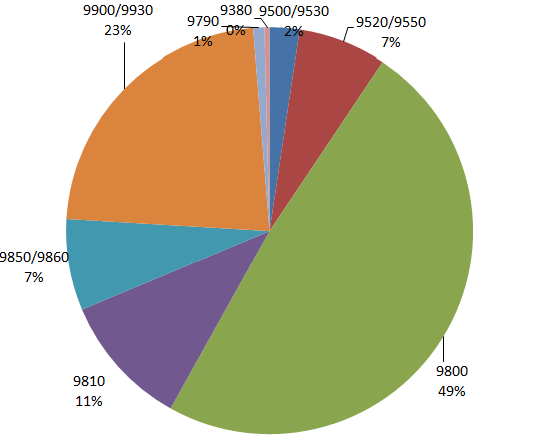
While the BlackBerry Torch 9800 is the most popular touchscreen devices with 48.7% marketshare, the BlackBerry Bold 9900/9930 is clearly catching up as the most popular of the BlackBerry 7 devices. Also it looks as if I was right in regards to the production of the 9380 and 9790 being a waste of RIM’s time, and unneeded fragmentation.

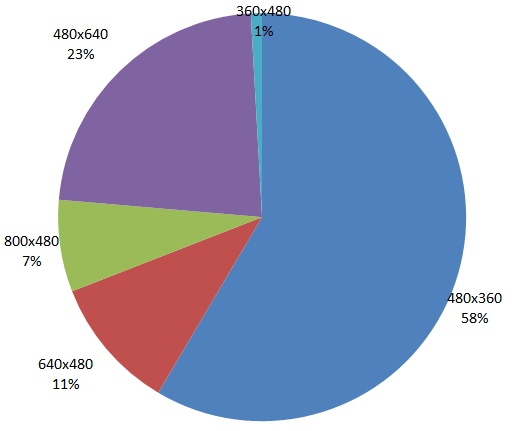
Looking at the distribution of screen resolution on BlackBerry touchscreens shows why supporting the 9790 is not a priority for any developers. Accounting for just 0.88% of all touchscreen devices it is far to unique with no reason to purchases it instead of the Bold 9900. The Curve 9380 however can easily be supported due to its many similarities with the Torch 9800 and Storm series. In fact its 480×360 screen resolution is present in over half of all touchscreen BlackBerrys in the wild.

These stats are based on December downloads of the free strategy game Pixelated.

A second look at the benefits of localization

A first look at the benefits of localization back in October, found little evidence that there was that much to gain from adding the feature. Regardless support for Pixelated Plus (and its free sibling Pixelated) was expanded from English only to support a total of five languages with the release of version 3.0.

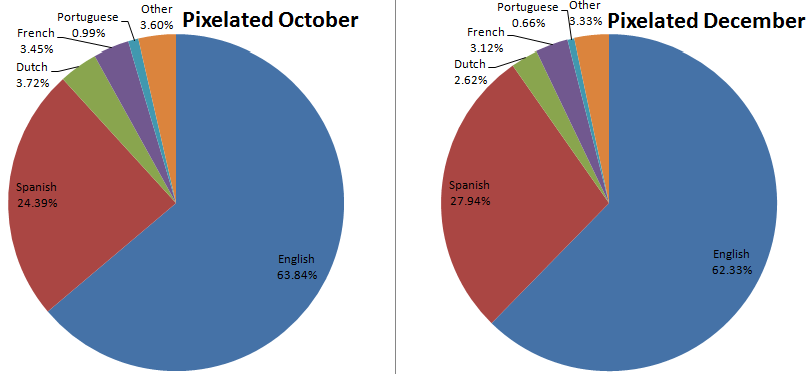
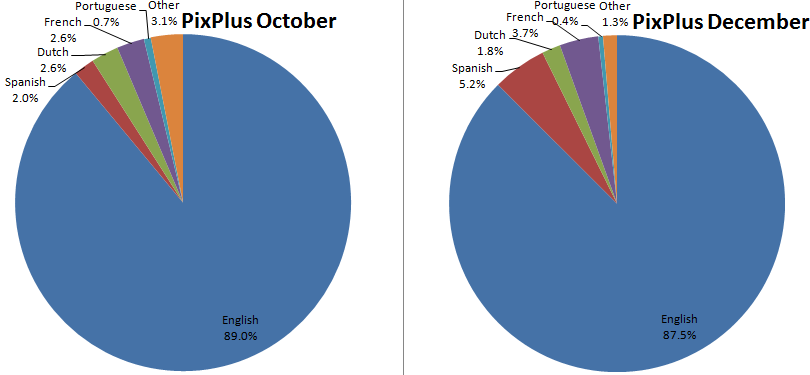
In the below charts percentages are shown from October (the month before the release of version 3.0) and December (the month after the release of version 3.0). All downloads and sales on the PlayBook were excluded from these stats. All languages that are not currently supported are lumped into the ‘Other’ category. First a look at downloads of the free game Pixelated in October and December.

English and Spanish are by far the most popular languages. After adding support for more languages there is a bit of an increase in the percentage of users with Spanish as their primary language, but a bit of a decrease among speakers of Dutch, while French and Portuguese are mostly flat.

The next charts show purchases of Pixelated Plus from October and December.

This chart shows an increase of percent of purchases made by users of Spanish and French. Even more interesting is that the increase seen here is larger then the size of the increase seen in the free version of Pixelated. Sales to users speaking Dutch, however, are down (similar to what was seen in the top graph).

So perhaps there are some advantages to localization. But the results are (at best) mixed. Still it is important to remember that not users have English as their preferred language.

Thoughts on Mike L. and Thorsten H.

Last night the news broke that Mike L. and Jim B. were stepping down as Co-CEOs of RIM. While this move will be loved on Wall Street, the thought of the company’s founders being pushed out scares me a bit in regards to the future of the companies products. Historically when the founders of a company step down the results are not good (as seen with Apple without Jobs and Yahoo without Yang).

Still things to seem to be promising about Thorsten Heins as CEO. For one he is being promoted from within the company. Secondly is that he has master’s degree in science and physics. My opinion is that technology companies need to be run by engineers rather then by businessmen.

Yesterday morning on twitter (well before any news broke) I linked to a piece in the Democrat and Chronicle about Kodak. The relevant part is below…

“You can trace the problems to when the MBAs kind of took control of the company,” Shippey said. There were plenty of people, he said, who saw the change coming and alerted the company. But it would have taken an innovator, not necessarily an MBA, to make the moves that were needed in a timely way.

So far the rumors about Heins are positive, so there is reason to be optimistic. But RIM must remain a technology driven company (even if that isn’t really what Wall Street wants).

10,000 Farkle hits its second anniversary

Two years ago 10,000 Farkle was released as my second game in BlackBerry AppWorld. Here are the highlights of the last two years.

History of Farkle

  • January 2010 – Version 1.0 released The first version of 10,000 Farkle was released in BlackBerry AppWorld.
  • May 2010 – Version 1.1 released This update added support for achievements.
  • September 2010 – Version 1.2 released Vast improvements to the animations, and support for OS6 devices.
  • February 2011 – Version 1.3 released Improvements to graphics and further OS6 support.
  • August 2011 – Version 1.4 released Support for OS7 devices was added.
  • January 2011 – Version 1.5 released Added auto-saving of game progress.

How to Play

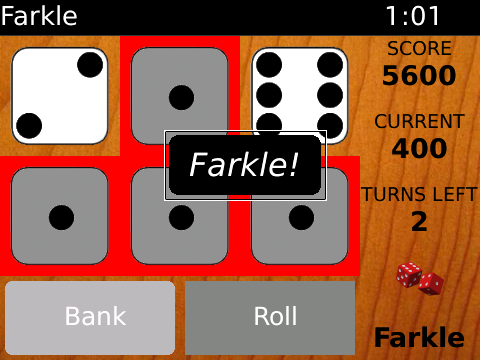
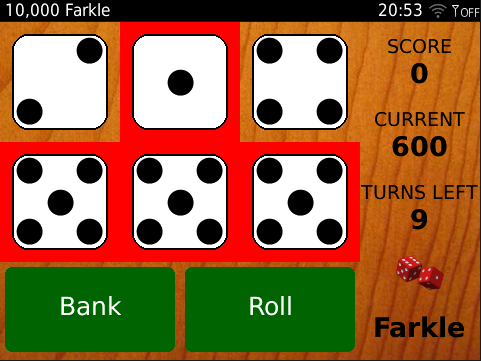
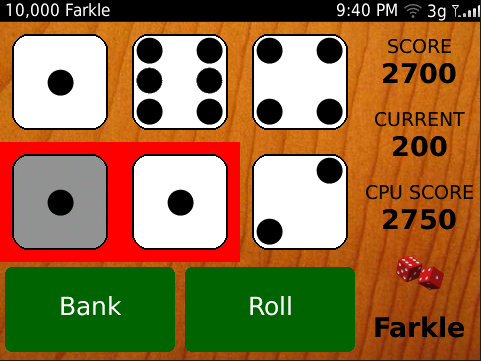
Farkle gives you six dice to roll and awards points for a straight, three pairs or three or more of the same number. Fewer points ares also awarded for each individual 1 and 5. Any dice that do not score can be re-rolled for additional points. If all 6 dice can be scored, all of the dice can be re-rolled on the same turn.

The skill in this game comes from knowing how far to push your luck, and which scoring combinations to take, and which to re-roll.

The default game mode gives you 10 turns to score as many points as you can. The 10,000 point mode is the traditional way to play, where the goal is to reach 10,000 points in as few turns as possible. The two competitive game modes “vs Friend” and “vs Computer” both use the traditional race to 10,000 points.

Links & Information
PlayBook OS versions

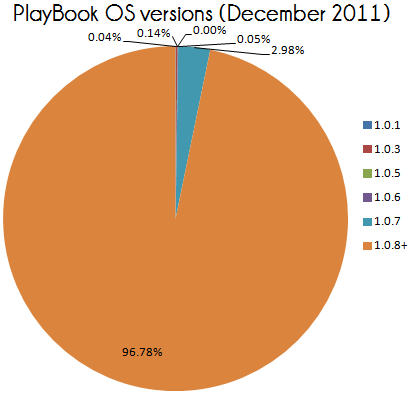
The above chart shows the breakdown (as of last month) of PlayBook OS versions currently in use. As was the case in September, the vast majority of users are running the latest OS.

Because I feel that it is unreasonable to expect end users to be running a beta version of the software, users of OS 2.0 (and other unreleased versions) were included in the group of OS 1.0.8 users. The percent of people running the beta was in the low single digits.

Data comes from December 2011 downloads of the free strategy game Pixelated.

Farkle updated to version 1.5

10,000 Farkle has been updated to version 1.5 in BlackBerry AppWorld. The biggest improvement in this update is that you can now exit the app in the middle of a game, and then resume the game, when you restart the application. This new version of Farkle also makes some improvements to the efficiency of the app, as well as some visual tweaks.

How to Play

Farkle gives you six dice to roll and awards points for a straight, three pairs or three or more of the same number. Fewer points ares also awarded for each individual 1 and 5. Any dice that do not score can be re-rolled for additional points. If all 6 dice can be scored, all of the dice can be re-rolled on the same turn.

The skill in this game comes from knowing how far to push your luck, and which scoring combinations to take, and which to re-roll.

The default game mode gives you 10 turns to score as many points as you can. The 10,000 point mode is the traditional way to play, where the goal is to reach 10,000 points in as few turns as possible. The two competitive game modes “vs Friend” and “vs Computer” both use the traditional race to 10,000 points.

Links & Information
Xploding Boxes updated

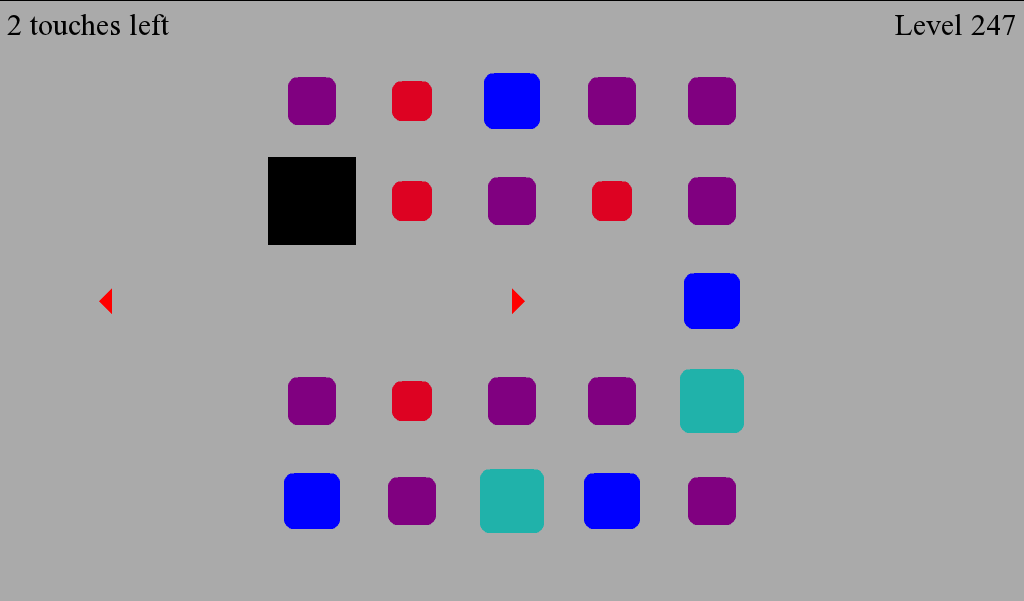
Xploding Boxes has been updated in BlackBerry AppWorld, and the Nook Bookstore, adding 20 additional levels, bringing the total up to 260.

About Xploding Boxes

Xploding Boxes is a strategy game for BlackBerry and Nook, where the goal of the game is to start a chain reaction that will explode all of the boxes on the screen. Each level gives you a different number of touches, and requires a different strategy to solve. The first 25 levels are free, while the full 260 levels can be accessed by making an in-application payment and requiring no further downloads. This game is available for the PlayBook, most smartphones running OS 5.0 or higher, and the Nook Color and Nook Tablet.

Links & Information

The Majority of PlayBook users are Canadian

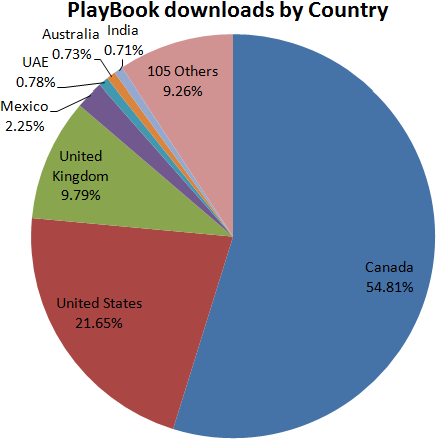
The above chart shows the country of PlayBook users based on downloads of the game Pixelated in the month of December. The game was downloaded in 122 different countries during the month, but more then half of the downloads came from Canada.

The top 10 countries were (in order) Canada, United States, United Kingdom, Mexico, United Arab Emirates, Australia, India, Indonesia, the Philippines, and Argentina.

There may be some sampling errors due to regional popularity of the game Pixelated, or the fact that the game is only available in English, Spanish, Dutch, French, and Portuguese. Also because data was only used from the month of December, these numbers may be affected by regional promotions and discounts during this time frame.

BlackBerry OS distribution

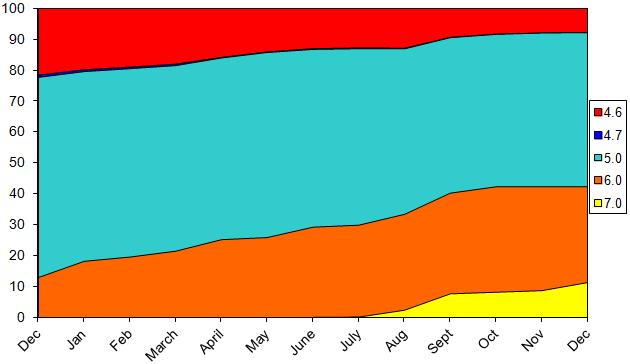
December showed an uptick in usage of OS 7.0 which is now up to 11.4 percent. This growth however, mostly came at the expense of users of OS 6.0 which saw little to no growth. There was also no significant growth in the use of OS 5.0 in the past month.

This data was taken from downloads of the popular BlackBerry strategy game Pixelated. Data shown on the chart is from the beginning of December 2010 through the end of December 2011.